Misdiagnosed With Type 2 Diabetes - How Kory Discovered LADA And Lowered Blood Sugar 75 Points In 3 Months!
If you have been told you have type 2 diabetes but your blood sugar still spikes into the two hundreds even when you eat very few carbs, there is a chance something important has been missed.
This is what happened to our client Kory.
He was originally diagnosed with type 2 diabetes. His blood sugar would shoot into the two hundreds even with small amounts of carbs. He was losing muscle, battling gas and bloating, and felt so fatigued that he needed daily naps and struggled to stay awake on his hour long commute. He tried:
Eating less and less and cutting out carbs
Metformin
Jardiance
Long acting insulin
Yet his blood sugar spikes continued and his energy kept dropping.
What finally changed everything was discovering that he had been misdiagnosed. He did not have classic type 2 diabetes. He had LADA, latent autoimmune diabetes in adults, often called type 1 point 5 diabetes. Once we addressed that and layered in The Pohlman Method, he lowered his blood sugar by 75 points in three months, came off Metformin and Jardiance, and was able to enjoy carbs again.
Who We Are And Our Root Cause Blood Sugar Approach For Misdiagnosed Type 2 And LADA
I’m Isaac Pohlman, a registered dietitian, fellow person with type one diabetes, and the CEO of The Pohlman Institute. Our team helps clients all over the world
• Balance blood sugar
• Lower A1C
• Improve insulin resistance
• Restore their health
All while still eating carbs and without relying only on medication. Our framework has three main phases:
Finding your sweet spots for carbs, movement, stress, and lifestyle so you can see fast blood sugar improvements without feeling restricted.
Reviving your metabolism with personalized nutrition and realistic routines so you have more energy while fasting and post meal numbers come down.
Achieving carb freedom by addressing deeper issues like mineral imbalances, inflammation, and nervous system stress, often using targeted lab testing and simple, sustainable changes.
If you are ready to bring your blood sugar into a healthier range, get clarity on what is really driving your numbers, rely less on medications, and feel better day to day, you can apply here to get support, guidance, and accountability from a team that truly understands blood sugar!
Kory’s Starting Point Misdiagnosed Type 2 Diabetes, Blood Sugar Spikes, And Exhaustion
When Kory first reached out, his main struggles were:
Blood sugar spikes into the two hundreds even with very low carb meals
Severe fatigue and sleepiness, needing daily naps
Difficulty staying awake during his commute to work
Feeling unproductive at home and less present with his family
Gas, bloating, and digestive discomfort
Ongoing muscle loss
He was doing what he had been told for type 2 diabetes management:
Taking Metformin and Jardiance
Using long acting insulin
Cutting back on carbs
Trying to eat less to avoid spikes
He was also working with an endocrinologist, but the traditional model meant he got one short visit every few months. When something did not work, he would stay stuck with the same plan for weeks without feedback or adjustments.
By the time he joined our program, he felt frustrated, confused, and understandably hopeless.
How We Realized It Was LADA Not Type 2 Diabetes
Inside The Pohlman Method we always look at the full picture, not just blood sugar readings. Several clues stood out:
His severe fatigue and daily crashes
His very low carb tolerance, where even small amounts of carbohydrate caused extreme spikes
Ongoing muscle loss despite trying to manage his diabetes
These signs often show up in autoimmune forms of diabetes such as type 1 diabetes and LADA. LADA is sometimes called type 1.5 diabetes because it has features of both type 1 and type 2. There is some insulin deficiency from autoimmune attack on the pancreas and often some insulin resistance as well.
We suggested that Kory talk with his doctor about running an autoimmune antibody panel to check for antibodies that could confirm the form of diabetes he has.
The test came back positive.
That meant Kory had been misdiagnosed. He did not have straightforward type 2 diabetes. He had LADA, latent autoimmune diabetes in adults. This explained why he could not tolerate carbs and why his blood sugar spiked so sharply. His body simply did not have enough insulin on board.
With this new information we were able to address the root problem instead of just giving him more type 2 medications on top.
Step One: Tailoring Insulin For LADA To Stabilize Blood Sugar
Once we knew Kory had LADA, the first priority was getting him on a more appropriate insulin plan with his doctor. Within our scope we:
Reviewed his continuous glucose monitor trends
Looked at how his blood sugar responded to meals, snacks, and corrections
Identified patterns where his current doses were not enough or were mistimed
Based on these patterns we gave data driven insulin suggestions for him to discuss with his doctor. We did not prescribe doses, but we gave realistic ranges and timing ideas so his doctor had better information to work with.
As his insulin regimen became better matched to his actual needs:
His blood sugar spikes reduced
He no longer saw such extreme jumps into the two hundreds with small amounts of carbs
He started to feel more stable and less drained
This blood sugar stability set the stage for the next phase of work.
Step Two: Increasing Meal Density And Carb Tolerance Instead Of Eating Less
Before working with us, Kory’s mindset was “the less I eat, the better my blood sugar will be.” He was constantly trying to eat fewer carbs and smaller meals to avoid spikes.
In reality, this was backfiring.
Very small, low energy meals can:
Keep you under fueled and fatigued
Limit the nutrients your body needs to handle blood sugar
Make the digestive system more sensitive
We moved Kory in the opposite direction.
We focused on dense, satisfying meals that were:
Rich in protein
Contained fiber
Included the nutrients that support carb tolerance and insulin sensitivity
Then we slowly increased his carb intake at a pace his body and digestion could handle. Because his blood sugar had been unstable for so long, we did not rush this. Gradual increases helped his system adapt without big swings.
Over time, this approach:
Improved his carb tolerance
Reduced gas and bloating
Gave him more steady energy after meals
Helped him begin gaining muscle again
Instead of fearing food, he began to see meals as a way to fuel his body and support his blood sugar.
Step Three: Movement, Stress, And Time Outside
The last key piece was addressing stress and movement.
Kory had:
A very long, stressful commute
A demanding job
Little time built into his day to decompress
Chronic stress can raise blood sugar, worsen digestive symptoms, drain energy, and make it harder to build muscle. For someone with LADA, stress can also make blood sugar more volatile.
We worked with him to:
Build short breaks into his day, including time outside
Add gentle movement that fit his schedule and did not leave him exhausted
Prioritize his own needs alongside work and family so his nervous system could calm down
By giving his body time and space to reset, stress was no longer constantly pushing his blood sugar and symptoms in the wrong direction.
Results: Lower Blood Sugar 75 Points, Off Metformin And Jardiance, Eating Carbs Again
After three months of this combined approach:
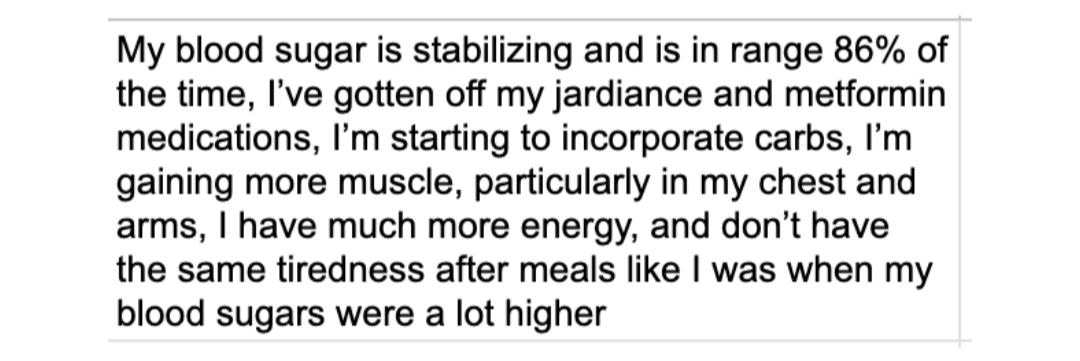
Kory lowered his blood sugar by 75 points
He was able to stop both Jardiance and Metformin with his doctor’s guidance
He could enjoy foods he never thought he would eat again, including pizza and cookies, without massive spikes or guilt
His energy improved and he no longer needed daily naps
He could exercise and do structured workouts again
He started gaining muscle instead of losing it
His digestive issues like gas and bloating were significantly reduced
He felt like he had sustainable habits for long term health for himself and his family
Most importantly, he finally had the correct diagnosis and a plan that matched what his body actually needed.
What Kory’s LADA Case Study Means For You
If you were diagnosed with type 2 diabetes but:
Have very low carb tolerance
See big blood sugar spikes from tiny amounts of carbs
Feel severely fatigued and are losing muscle
Do not feel better on typical type 2 medications
it may be worth discussing LADA, latent autoimmune diabetes in adults, with your doctor and asking about antibody testing.
Whether you have type 2 diabetes or LADA, or another blood sugar issue, this doesn’t have to control your life. A root cause approach that includes:
Correct diagnosis and appropriate insulin use (while working on lifestyle and nutrition to minimize the need)
Satisfying, nutrient dense meals instead of constant restriction
Gentle movement and stress support
Mineral and metabolic support when needed
can make it possible to lower blood sugar, feel better, and still eat carbs in a way that works for your body.
If you are ready to bring your blood sugar into a healthier range, get clarity on what is really driving your numbers, rely less on medications, and feel better day to day, you can apply here to get support, guidance, and accountability from a team that truly understands blood sugar!